01.1 · Research project
Detection of unmanned aerial vehicles
A camera and an FMCW radar at 10 GHz detect drones together – the camera recognises the drone, the radar measures its range and velocity.
About the project
A camera and an FMCW radar at 10 GHz detect drones together. The camera recognises them with the YOLOv8 algorithm on an NVIDIA Jetson platform, while the radar measures range and velocity – together they are more reliable in different weather conditions.
Each sensor has its weaknesses: a camera recognises an object's shape well but is hampered by poor visibility, fog and backlight; a radar is insensitive to lighting but cannot tell by itself what the object is. Combining both sources of information gives more reliable detection.
How it works
- The camera captures the image, and the YOLOv8 detector on an embedded NVIDIA Jetson platform finds and marks the drones in it.
- The FMCW radar at 10 GHz transmits a frequency-modulated signal and measures the target's range and radial velocity from the reflection.
- Fusion combines the detections of both sensors, so the system detects the drone even when one of the sensors fails.
| Type | Research project |
| Related work | Master's thesis, 2025 |
| Field | Machine vision · Radar signal processing |
| Sensors | Camera, 10 GHz FMCW radar |
| Hardware | NVIDIA Jetson |
| Algorithm | YOLOv8 |

Radar system and response to a drone

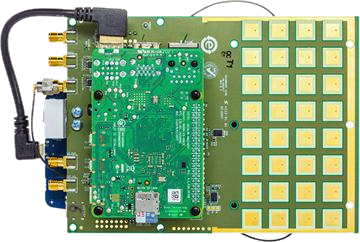
The picture shows a radar board with a phased-array antenna and the Analog Devices ADAR1000 beamformer – a four-channel beamformer for the X and Ku bands (8–16 GHz). By setting the phase and gain of the individual antennas, it steers the radar beam electronically, without rotating the antenna mechanically.
In the background is the radar's response to a drone in a range-Doppler display: the horizontal axis is radial velocity, the vertical axis range. MTI processing ( moving target indication) removes reflections from stationary objects around zero velocity, so the drone stands out as a bright point. Next to it, horizontal micro-Doppler lines appear because of the rotating propellers.