01.7 · Master's thesis
Removing speckle noise from SAR images
A deep neural network removes grainy speckle noise from a radar image while preserving edges and details.
About the project
SAR radar images are covered by grainy speckle noise that makes them hard to interpret. Deep neural networks remove it while preserving edges and details – a basis for more accurate image analysis.
Speckle noise ( speckle) is not a sensor fault but a consequence of coherent imaging: the reflections of many small scatterers within one resolution cell add up with different phases. Classic filters reduce the noise but also blur the edges. A neural network learns to separate noise from structure in the image.
For training, the network needs pairs of images: a noisy image and a clean reference image of the same area. The master's thesis uses a multi-temporal approach – the reference image of the Maribor area is the average of more than 400 Sentinel-1 images. Averaging cancels the speckle noise, which is random from image to image, while the terrain structure remains.
How it works
- Data preparation: Sentinel-1 images of the same location are processed, co-registered and terrain-corrected.
- The reference image is obtained by averaging more than 400 co-registered images.
- A convolutional network with an encoder and decoder and a continuous attention module (CAM) learns the mapping from the noisy image to the reference image.
- Comparison with eight classic filters (Boxcar, Median, Frost, Gamma MAP, Lee, Refined Lee, Lee Sigma, IDAN) using PSNR and SSIM – deep learning achieved the best results.
| Type | Master's thesis |
| Author | Tadej Habjanič |
| Supervisor | Dušan Gleich |
| Field | Remote sensing · Radar signal processing |
| Data | Sentinel-1, Maribor area |
| Reference | Average of more than 400 images |
| Method | Encoder-decoder CNN with a CAM attention module |
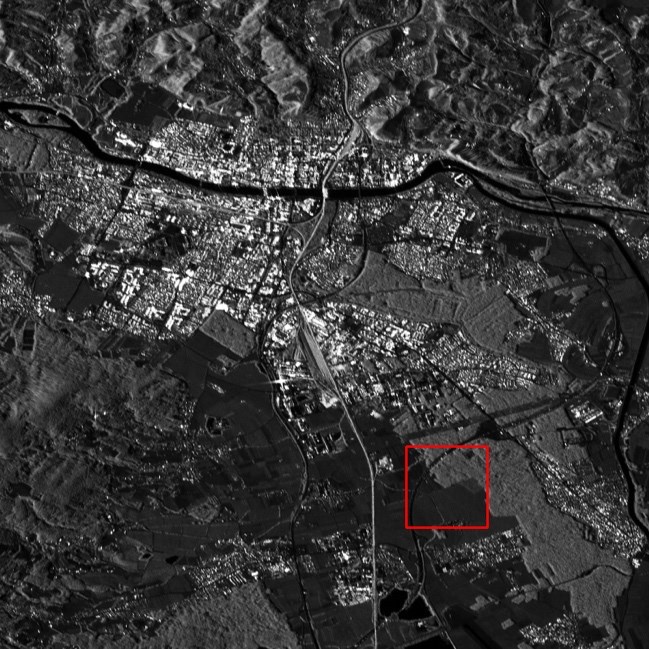
Zoomed detail: noise, deep learning and reference
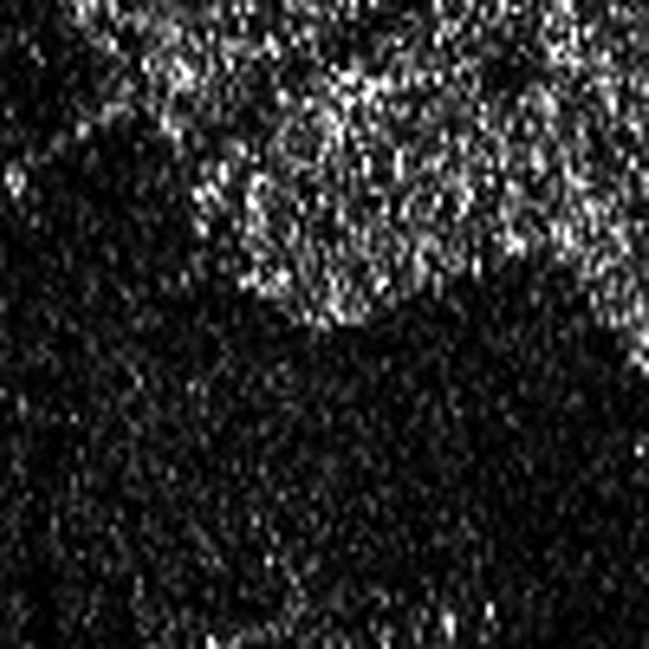
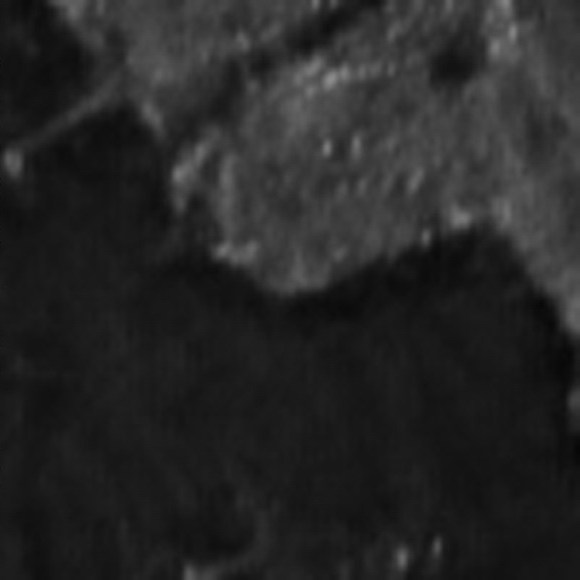
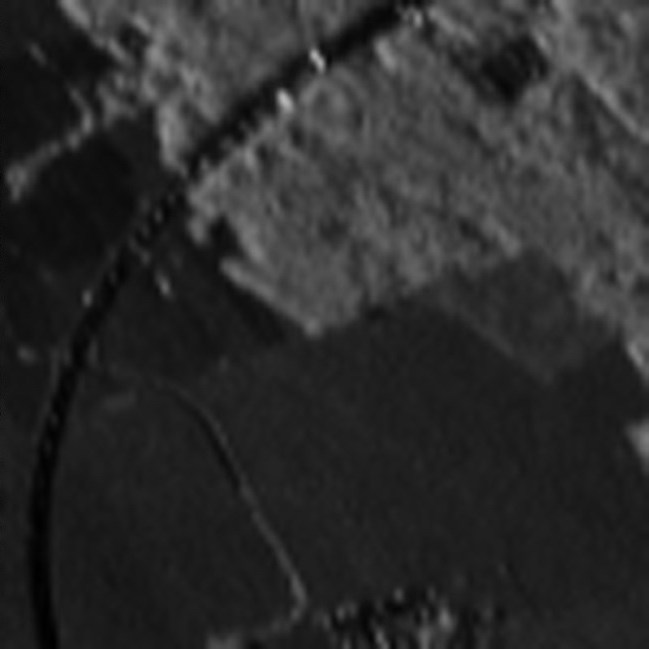
The area marked with a red square in the image above. Images: T. Habjanič, Removing speckle noise from SAR images using deep learning, master's thesis, UM FERI.