Electrical Engineering · Automation and Robotics

Don't just operate machines – teach them to think.

Automation and robotics is the science of autonomous systems – from a robot arm in a factory and a smart home to a drone. At FERI in Maribor you learn how to design them, program them and bring them into the real world.

01 / What you will study

NATURE, ENGINEERING, INDUSTRY

What do a fly, a drone and a factory have in common?

They are built from similar building blocks and perform the same functions, but in three very different forms.

Read more …

Nature, aviation and industry solve the same tasks: sensing, deciding, acting, connecting and providing energy. Choose a building block and see how a fly, a drone and a filling line implement it.

FLY

The smallest and the most economical. Agile, crash-resistant and it “recharges” itself.

DRONE

Carries a payload, knows where it is thanks to GPS and communicates with a remote human by radio.

FILLING LINE

Tireless and precise: it works day and night and checks every single product.

AND WHERE DO YOU COME IN?

Studying automation, you learn all the building blocks – and how to use them in a drone, a robot or a factory.

↻ Drag to rotate · click a part

Sensors

  • Sensors

Control system

  • Control Systems I
  • Systems Theory
  • Signals
  • Modelling and Identification
  • Control Systems II
  • Introduction to Robotics

Actuators

  • Electrical and Electromechanical Converters
  • Control Systems Components

Energy source

  • Industrial Electronics

ICT

  • Communication in Automation
  • Digital Signal Controllers in Automation

Supporting knowledge

  • Digital Logic Design
  • Introduction to Electronics
  • Analysis II
  • Microcontrollers
  • Elective Mathematics Course
  • Elective courses

Sensors

  • Sensor Technology I
  • Sensor Technology II
  • Standardization and Quality Assurance

Control system

  • Signal Processing
  • Controllers and Microcomputers
  • Logic Control Engineering
  • Control Techniques I
  • Control Engineering II
  • Modelling and Simulation
  • Robotics I
  • Industrial Plant Automation

Actuators

  • Electronic Systems Components
  • Electromechanical Converters
  • Actuators

Energy source

  • Industrial Electronics
  • Power Electronics Systems

ICT

  • Communication in Automation

Supporting knowledge

  • Digital Logic Design
  • Information Technology and Documentation
  • Analysis II
  • Elective Courses I, II, III

Sensors

  • Sensor Systems
  • Optoelectronics
  • Machine Vision

Control system

  • Control Systems Design
  • Advanced Control Systems
  • Intelligent Control for Production Industry
  • Robotic Systems
  • Embedded Systems

Actuators

  • Energy Conversion
  • Electronic Components

Energy source

  • Power Electronics
  • Power System Optimization

ICT

  • Remote Control Systems
  • Internet of Things and Artificial Intelligence for Embedded Systems
  • Mobile and Ubiquitous Electronic Systems

Supporting knowledge

  • Electromagnetic Field Theory
  • Electrodynamics
  • Electronic Systems for Space Applications
  • Quality, Reliability and Testing

Practicum in Automation and Robotics – Project

You bring it all together in your own project that runs through the whole programme.

The course list is based on presentation materials of the Institute of Automation. Courses of the master's programme Electrical Engineering, Automation and Robotics option, are based on the 2024/25 exam schedule; some of them are electives. The current curriculum is published at feri.um.si.

02 / How an autonomous system works

Sense. Decide. Act. Repeat.

Autonomous systems sense their surroundings, make their own decisions and act on the world – without a human. Every autonomous system is built from sensors, actuators and a decision-making, or smart, system.

The flashing blocks are clickable

Closed loop

How to use

Click a flashing block

Each block in the loop has its own job: the reference sets the goal, the sensor measures, the controller decides, the actuator acts. The arrows show how the signals travel.

Live loop simulation

setpoint routput ydisturbance

03 / Students' final theses

From an idea to a machine that works.

Final theses of automation and robotics students at UM FERI.

Robotics · Control

Agile two-wheeled robot

Master's thesis · supervisor Andrej Sarjaš

Design and implementation of an agile two-wheeled mobile robot with a movable upper body

The thesis designs and builds a two-wheeled robot with a movable upper body that balances itself, drives fast and overcomes obstacles. Balance is maintained by an LQI controller in a cascade loop on an STM32 microcontroller, and its operation is confirmed by simulations and tests on the real robot.
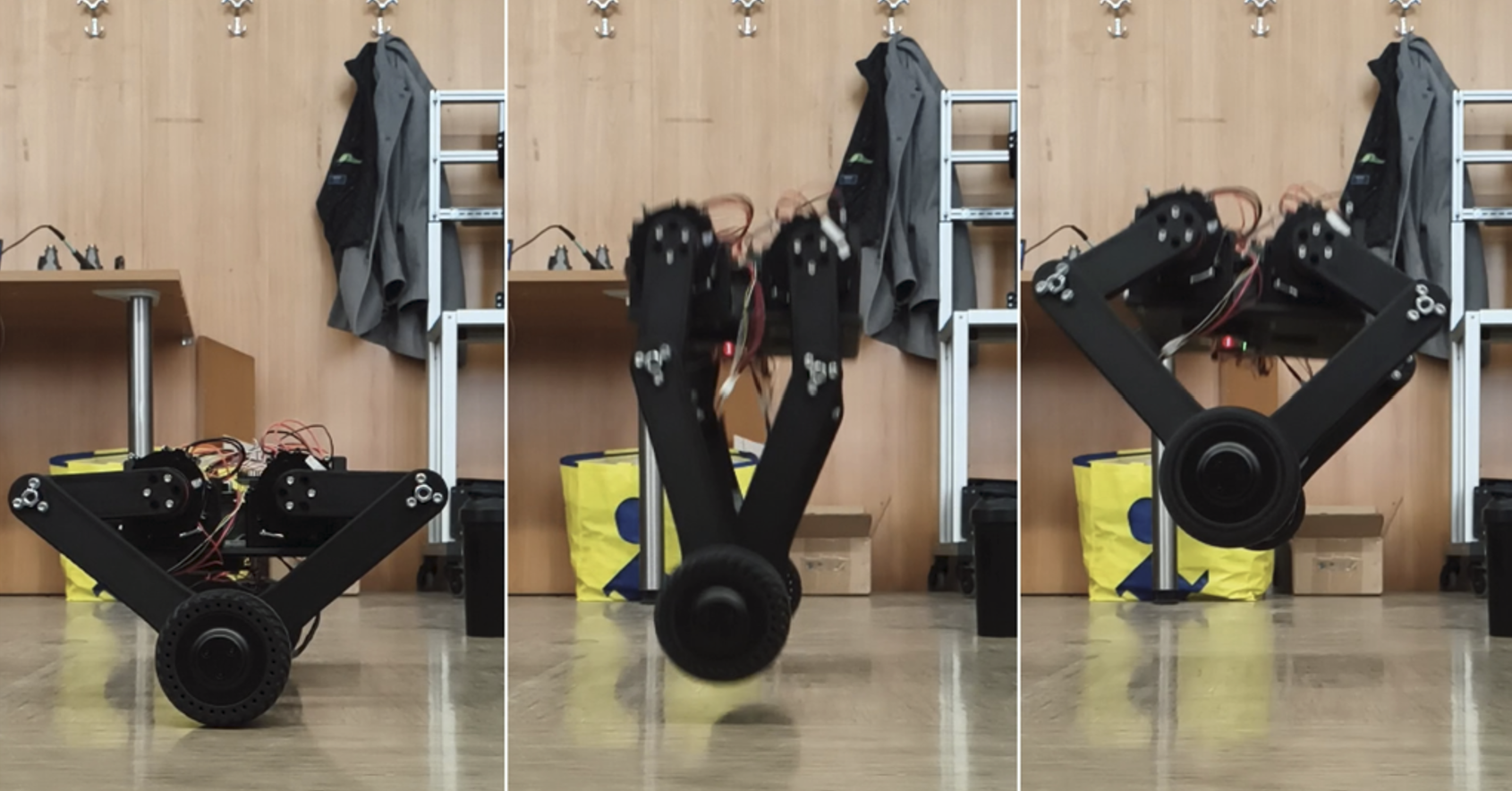
Trije položaji dvokolesnega robota z gibljivim zgornjim trupom
Photo: LOSDV, UM FERI

dvokolesni_robot.sim u = k₁x + k₂ẋ + k₃θ + k₄θ̇

Simulation modelled on the interactive model at jontofant.github.io.

Sensors · Photonics · Agriculture

Touch sensor for picking raspberries

Master's thesis · supervisor Simon Pevec

Fibre-optic tactile sensor with an application in harvesting small fruit

The thesis develops a fibre-optic touch sensor with four sensing units based on a Fabry–Pérot interferometer, embedded in a soft elastomer membrane that mimics the feel of human skin. The sensor reliably detects forces of up to 1.5 mN, so a robotic gripper holds raspberries firmly enough without crushing them.

prijem_maline.sim force → shift of the interference spectrum

The gripper is open

Illustration: the force limits are approximate. The force compresses the membrane, the interferometer gap shortens and the spectrum shifts – this is how the sensor “feels” touch.

Control · Embedded systems

Rotary inverted pendulum

Master's thesis · supervisor Andrej Sarjaš

Control of a rotary inverted pendulum with a remote measuring point

The thesis builds a rotary inverted pendulum in which a microcontroller on the rotating part measures the rod angle and sends it via an NRF wireless module to the main controller. A PID controller, polynomial synthesis and a state-space controller are compared – the latter performed best, swinging the rod upright and holding it there.

krozno_nihalo.sim hanging → swing-up (energy) → catch (state space)

Increase the delay of the wireless measurement and see when the controller can no longer handle the pendulum.

Artificial intelligence · Control

A controller that tunes itself

Master's thesis · supervisor Marjan Golob

Optimisation of online tuning of controller parameters using hybrid fuzzy systems

The thesis investigates how hybrid fuzzy systems tune PID controller parameters online when the process is non-linear or changing. The best results came from combining fuzzy inference with particle swarm optimisation, which in simulations improved control compared with a classic PID controller.

mehki_pid.sim particle swarm + fuzzy rules → PID gains

Illustration: the process is more “sensitive” at high values. The classic PID overshoots there, while the fuzzy rules adapt the gain to the error and the operating point.

Artificial intelligence · Industrial automation

Temperature controller with artificial intelligence

Bachelor's thesis · supervisor Nenad Muškinja

Use of a temperature controller with built-in artificial intelligence in industrial applications

The thesis tests an OMRON NX-TC industrial temperature controller with built-in artificial intelligence on a two-segment laboratory wind tunnel. On-off control, PID, 2-PID and adaptive control with self-tuning are compared; the work was supported by MIEL Elektronika.

vetrovnik.sim heater → air → sensor (delay)

Illustration: self-tuning first measures how the process oscillates with a short relay test, then computes the PID parameters by itself.

04 / From study to employment

Studying Automation and Robotics

04.1 · Why automation

Why study automation

Breaking into global markets is becoming harder not only because products are more complex, but also because of constant competition between manufacturers who want to bring their products to market as fast as possible. Successful global companies renew themselves by introducing multidisciplinary teams of experts who can adapt quickly to the development demands of the market.

Fields of study

  • industrial electronics
  • informatics and microcomputing
  • logic control and control engineering
  • electric motor drives
  • communications
  • cybernetics and robotics

04.2 · Study

Who can study and what they learn

Any student who has successfully completed the first year of the Electrical Engineering programme at FERI, regardless of whether they enrolled after a general upper secondary school (gimnazija), an electrical engineering secondary school or a similar technical secondary school.

After acquiring in-depth knowledge of the natural sciences and fundamental electrical engineering subjects, students go deeper into core professional subjects in systems theory, control, modelling, artificial intelligence, identification, computer science, informatics, etc. They can gain more specialised knowledge in two main areas:

Production automation

Robotics

Process automation

Automation and cybernetisation of processes

Within these two main areas we also have suitable laboratories, which allow every student to work according to their abilities and interests. Alongside the professional courses, students gain knowledge of measurement and control engineering, robotics and, in particular, computer control of all kinds of processes.

04.3 · Graduate profile

What graduates can do

First cycle

Computer control of industrial processes

Students acquire theoretical and practical knowledge of computer control of industrial processes. They are trained to design control technology and information systems for industrial processes, buildings and infrastructure facilities. Their knowledge meets the requirements for modernising existing facilities and building new automated plants. They are able to carry out a project according to the principles of the life cycle.

They acquire the following knowledge: sensors and measurement of non-electrical quantities, actuators, controllers, programmable logic controllers, supervisory and process computers, communications, industrial software, internet connectivity, basic and application programming languages, process value display units, documentation, process modelling and identification, and design of simpler control systems.

Second cycle

Process informatisation

Students build on the knowledge acquired in the first cycle. They are trained to plan and carry out process informatisation projects covering the digital factory, digital buildings, and infrastructure and energy systems with full integration of processes and IT solutions.

They are qualified for independent work on development and research projects and on projects renovating facilities and process information systems, including modern SCADA, MES and ERP systems for supervising and managing integrated processes at a high level of management. They acquire knowledge of process control, monitoring and supervision, fault detection, and design of embedded systems combined with modern internet-based and wireless communications; they extend their knowledge of identification, modelling, simulation and control, and learn about the non-technical aspects of systems management and economics.

04.4 · Employment

Everything is being automated. Engineers who know how are in demand.

Graduates work wherever processes are automated and digitalised: in industry, energy, transport, research institutes and education – or they start their own company. Their competences also open the way to management positions.

Digital factory

Robots, PLCs, MES and ERP systems

Energy

Power plants, grids, renewables

Smart buildings

Monitoring, heating, infrastructure

Research and development

Sensors, photonics, embedded systems

Some of the companies we work with

Siemens · ABB · Yaskawa · National Instruments · Iskra · Kolektor · Domel · Metrel · Gorenje · Cinkarna · Impol · Corning · HSE · Seltron