Computer control of industrial processes
The Laboratory for Process Automation carries out basic and applied research and industrial projects in computer-based process automation in industry.
400+
bibliographic items
60+
national and international projects
100+
supervised bachelor's theses
1999
first AIG conference in Maribor
Laboratory
From the sensor to the information system
The laboratory's work focuses mainly on computer process control, algorithm implementation, development and improvement of supervisory systems and interfaces, MES systems, automation of processes and facilities, measurement of non-electrical quantities, actuator technology, development of advanced control algorithms, process modelling and identification, fault detection and identification, etc. For many years we have passed the knowledge and experience gained on projects on to younger generations through teaching, supervision and practical training. The Laboratory for Process Automation is part of the Institute of Automation at the Faculty of Electrical Engineering and Computer Science, University of Maribor.

From PLC to MES
The laboratory's research focuses mainly on computer process control, PLC, SCADA and MES systems, automation of processes and facilities, measurement of non-electrical quantities, intelligent control – fuzzy controllers, process modelling and identification, fault detection and identification, and intelligent buildings. We have modern equipment that we continuously upgrade together with our partners. In recent years we have paid much attention to the implementation, connectivity and upgrading of SCADA systems, and we are increasingly looking towards MES systems, which link the technological and business levels of management. At the application level we develop embedded systems for measurement instrumentation and for the process control level, models of process systems, and we use modern communication technologies for industrial connectivity, open-source software for system control and complex information systems for information, distribution and alarming.
Automation and Robotics
We teach in the university and professional programmes in Automation and Robotics, where the Bologna study programme started in October 2007. The automation courses taught by the laboratory are Control Systems Design, Control Systems Components, Modelling and Identification, Actuators and Industrial Plant Automation. Besides our own faculty, we also teach the course Electrical Engineering in the Technical Education programme at the Faculty of Education.
Networks and conferences
We are active members of socio-technological networks and organisations in Slovenia and abroad, such as the Slovenian Society of Automation Engineers, within which we have organised the biennial conference Automation in Industry and Economy – AIG in Maribor since 1999. We are also a founding member and council member of the technology network Process Control Technology, one of four technology networks in Slovenia.
The laboratory's successful work is confirmed by more than 400 recorded bibliographic items, including more than 30 original scientific and professional papers and conference papers, as well as the supervision and co-supervision of more than 100 bachelor's theses, 4 master's degrees and 1 doctorate; 3 bachelor's theses and 1 master's thesis received the Bedjanič Award. We have also taken part in more than 60 national and international projects, organised professional conferences in automation and cooperated internationally with foreign educational and research institutions. We always strive to maintain contacts with industry and want to strengthen knowledge transfer to industry.
Head of Laboratory
doc. dr. Nenad Muškinja
01 / About the laboratory
Research, teaching and cooperation
Scientific, research and professional work in the laboratory
The scientific, research and professional work of the laboratory is reflected in numerous active and successfully completed projects. In recent years we have successfully carried out the following projects:
- Testing and validation of a system for alarm and event acquisition and chronology at the Šoštanj Thermal Power Plant (TEŠ), in cooperation with Metronik
- Fuzzy control of digital welding power sources for MIG/MAG arc welding processes, for Varstroj
- Glenrothes Distillery whisky distillery project, funded by the European Eureka programme, in cooperation with Miel d.o.o.
- Eureka project Fuzzy Control for Distributed Systems, completed in 2005
- Intelligent House project, in which a model of an intelligent house based on LonWorks technology and TCP/IP communication was designed and built
- Project IST-2001-32316, INES Industrial Embedded Systems, EU 5th Framework Programme
- Research and development projects on electricity meters in cooperation with ISKRAEMECO
- Development of an optimal model of the steam generator process for a zeolite plant in cooperation with SILKEM, Kidričevo
- Development of modern control methods for heating and cooling of residential and commercial buildings in cooperation with EVACO Maribor
- KC STV – RRP2 – Web-based, remote and distributed control technology
- EUREKA NEURO-TEMP – A new approach to temperature process control based on soft computing methods
- Supervisory fuzzy controller for coordinated distribution of process steam
Diver buoyancy controller using a buoyancy compensator.
We are a founding member of the technology network Process Control Technology, one of four technology networks in Slovenia. Within the Centre of Excellence for Modern Control Technologies we are carrying out two projects: Remote and Distributed Control Technology, and a Decision Support System for Production Control.
In cooperation with the Faculty of Electrical Engineering and Computing in Zagreb, within the project Fault-Tolerant Control System for Hydroelectric Power Plants, we are carrying out the basic research project Fault Diagnostics, which deals with fault detection in technical systems, with an emphasis on fault detection in real industrial systems.
Basic research is carried out within a research programme. Until 2005 we led the research programme Automation; in the current period we have joined our research capacities with the Institute of Robotics in the joint research programme Mechatronic Systems.
Linking research and teaching
Research and teaching are closely linked, as lectures and exercises are based on research results. We pay great attention to equipping the laboratories, where we invite students to work in their free time as well. The automation programme is organised so that, in addition to lectures and laboratory exercises, we run seminars and student projects. Seminars consist of several topics that students present publicly at the end of the semester.
Senior students always take part in research and development tasks, gaining additional, mainly practical knowledge; they also get to know the clients and partners, which later makes it easier for them to find a job.
Student work often continues into a bachelor's thesis, so the student completes an extensive piece of work that gives them the chance to master complex practical knowledge. More and more theses are done as team theses, in which 3 to 4 students work on the same project, each covering part of the whole. In this way students learn the teamwork that future employers expect, and they have proved to like this way of working, as they learn to cooperate and help each other.
Research and teaching equipment of the laboratory
Our laboratory has always been known for good equipment, which we have obtained in many different ways. Most of it we earned through work: on many projects we received equipment instead of payment and used it to carry out the project.
Much of the software in particular we received as gifts from our loyal partners or bought at a very favourable price. Our latest purchases were computer equipment and a complete renovation of the laboratory, paid for with structural funds and projects within the Centre of Excellence for Modern Process Control Technologies. From the same source came our latest purchase, an MES system, which will also be used in exercises and seminars.
Links with other scientific research institutions
Our cooperation extends in many directions. We cooperate most intensively with universities in Zagreb, Brno, Bratislava, Prague, Kielce (Poland), Miskolc (Hungary), Plovdiv and Gabrovo (Bulgaria), Košice, Split, Skopje and Graz. This is because since 1997 we have continuously participated in and co-coordinated a CEEPUS project, and over this time we have developed not only professional but also friendly relations with colleagues from these centres.
Within CEEPUS, one of the projects for exchanging professors and students, we send students abroad for a semester and recognise the study obligations they complete there when they return. Of course, we are also in very close contact with colleagues from the Faculty of Electrical Engineering in Ljubljana and the Jožef Stefan Institute.
Links with industry in Slovenia
In Slovenia we cooperate extensively with users and contractors, including Miel-Omron, Metronik, Synatec, Liko pris, Iskraemeco, INEA, TELEM, EVACO, Silkem, Talum, Tovarna sladkorja, Lek, Varstroj, AMI, Siemens, etc. What we share are mainly technology projects in which we have taken or are taking part. We are also connected with Slovenian companies through the technology network Process Control Technology, which we formed in 2003, and through the Technology Platform for Embedded Systems and the ARI centre.
Cooperation is not limited to joint projects but also includes consulting, participation in their committees, research groups, studies and the like. Perhaps our close ties with industry are also why we have always found many sponsors happy to support the AIG conference.
02 / Laboratory activities
Our areas of work
Process automation
At the level of basic and applied research, in cooperation with industry and with students, the Laboratory for Process Automation works mainly with the following automation elements:
- Controllers of various manufacturers and designs.
- Process models such as a distillery, a tubular heat exchanger, an air conditioning unit, an industrial furnace, a liquid level and flow control model, connected vessels, pressure models, an electric generator with a hydraulic motor and servo valve, an inverted pendulum, a ball in a magnetic field, an intelligent house model and various educational process models (AEG, balance control, …).
- Pumps, control valves, frequency converters, …
- Classic industrial sensors.
- We have a large number of devices and equipment from well-known manufacturers: Omron, Siemens, OPTO 22, Moeller, GE Fanuc, Schneider Electric, LonWorks, MATLAB, LabVIEW, …
The laboratory's research in process automation focuses on:
- Fuzzy modelling, control and identification.
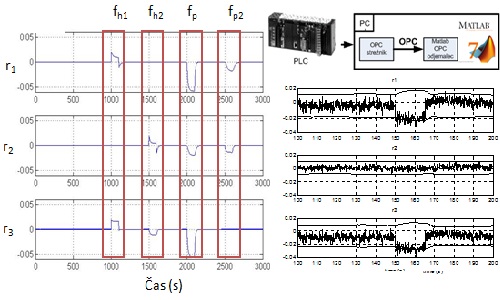
- Fault detection in control systems, covering classic modelling, identification, process supervision and control, fault detection and isolation, and development of identification and diagnostic algorithms for real-time systems and simulation models.
- Intelligent buildings.
- Supervisory control systems, PLC – Matlab – PLC links via OPC technology.
- Modelling and control of mechatronic systems – inverted pendulum, ball and beam, ball in a magnetic field.
- Remote and distributed control systems.

Fault detection and diagnosis
Most industrial processes today are controlled automatically under the supervision of an operator, who manages the process in line with the requirements and procedures of the technology. The automation system takes care of control and the execution of control loops, the transfer of information between systems and the operator, basic protection, etc. Disturbances, environmental influences and component ageing are just some of the causes of malfunction, where, besides technological, environmental and safety aspects, the most exposed is the economic loss due to an unplanned production stop. Fault detection, isolation and diagnosis subsystems are becoming an integral part of automation systems, primarily to achieve faster response and coordination of fault correction, with the main goal of detecting a fault early, before it develops into a failure.
Fault detection in industrial processes, however, is not as simple as it seems. The most common limitations are outdated equipment, insufficient knowledge of the processes and distrust of the system because of false alarms… But as the level of automation in industry rises and hardware and software develop, it is increasingly possible to build these systems into smaller and cheaper processes, using methods that were previously very difficult to implement (statistical approaches, demanding data processing, advanced control algorithms). A fault detection system is primarily intended to warn operators and assist their intervention, so real-time operation and detection of the irregularities it is designed for are desirable.
Remote and distributed control
