Automation is an ever-evolving interdisciplinary field that uses technology to ease human work or to extend people's mental and/or physical abilities.
Once this meant mechanising some simple processes; today it involves modern, advanced technologies for achieving a wide range of goals.
01 / Autonomous systems
The science of autonomous systems
An autonomous system is a system that can perform various tasks without human help or supervision. Autonomous systems carry out different tasks or complex processes and so help us in our work, our homes and our lives.
Today they are present in every area of human activity. Their importance is growing rapidly, as they directly and significantly increase human productivity, efficiency and safety, while relieving people of monotonous, unproductive or dangerous tasks.
At home
Central heating that takes care of our comfort with minimal energy use.
In industry
Production systems that increase productivity, added value and product quality.
In space
Interplanetary probes and robots that independently explore distant planets in extreme environments completely hostile to humans.
02 / Closed loop
Structure of an autonomous system
Automation incorporates and combines knowledge from logic control and control theory, sensors, actuators, (tele)communications, electronics, informatics, machines and devices, computer science, processes, etc. A system that performs autonomous tasks in an environment consists of:
Sensors
Acquire information from the environment.
Control system
Analyses the information from the environment and controls the actuators.
Actuators
Act on the system or the environment in which the system operates.
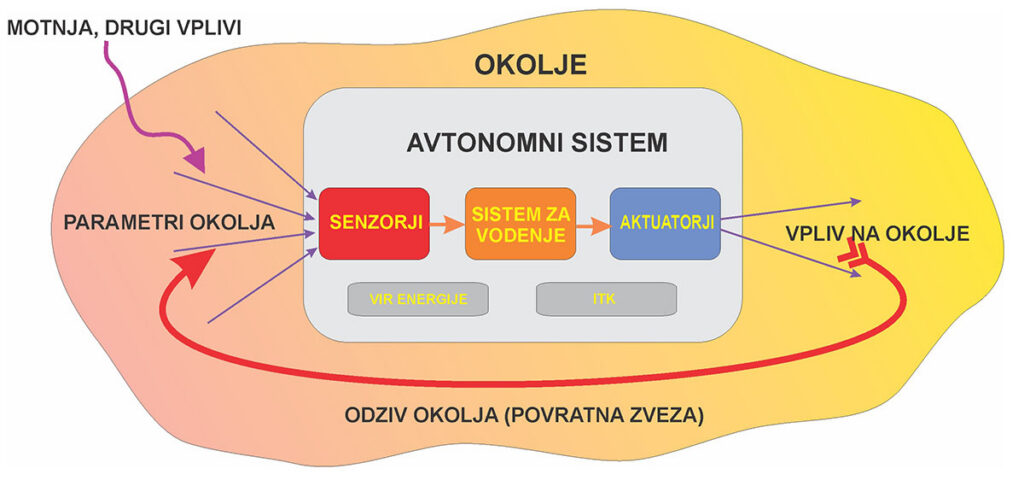
The figure also illustrates one of the fundamental principles on which automation systems rest: the closed loop. In closed-loop control, an autonomous system uses sensors to acquire data from the environment in which it operates or which it controls. It then analyses this data and often compares it with other available information and past data. Based on this analysis, the control system drives the actuators, which act on the environment. The changes in the environment caused by the actuators are detected by the sensors. This completes, or closes, the control loop.
However, the environment is affected not only by the actuators but also by a range of other predictable, less predictable or unpredictable phenomena. It is the closed loop that makes it possible to adapt to and handle these unpredictable influences in a way that ensures optimal operation of the autonomous system. There are various closed-loop control principles with which different desired properties of complex processes can be achieved.
03 / Computing
Automation and computing
Autonomous systems are much more than a closed loop. Modern automated systems rely heavily on information and communication technologies, with which they achieve various goals:
- various closed-loop control principles for achieving the desired properties of complex processes,
- robotic technologies for ensuring the flexibility of individual systems within automated series production,
- data processing, transfer and distribution for automating information flows, and
- artificial intelligence techniques for fast and effective decisions.
All these goals require handling large amounts of information in real time, which is only possible with advanced computer technology. Automation and computing meet in the use of computer technology to solve engineering problems such as the design, analysis and production of technical products, and the planning and control of various technical processes.
04 / After graduation
Graduate profile
The interdisciplinary nature of the programme gives graduates better employment prospects and greater flexibility and capability. In addition to applied, design and systems engineering skills, graduates will master programming and interface design for industry as well as the control of production and process operations.
Our mission is to educate first-class engineers who can work as engineers, researchers and managers in modern design, manufacturing, process and computer-aided industries.