01.9 · Master's thesis · 2026
A rocket that lands by itself
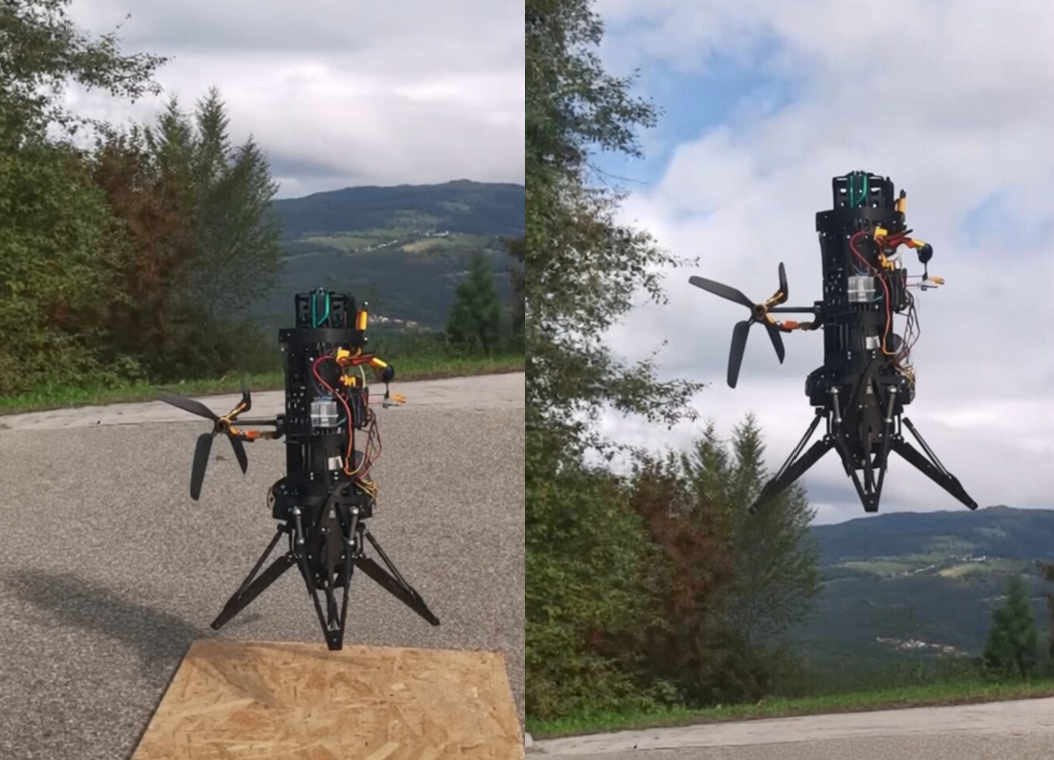
A prototype with an electric ducted fan and thrust vectoring hovers automatically and lands in a controlled way.
Illustration · take-off, hovering with a disturbance, landing
About the project
A prototype with an electric ducted fan (EDF) and thrust vectoring hovers automatically and lands in a controlled way. Stability is ensured by a cascade of controllers.
A rocket standing on its thrust jet is unstable – any small tilt quickly grows without intervention. By deflecting the thrust direction ( thrust vector control) the controller creates a torque that returns the rocket to the vertical, while controlling its altitude through the thrust magnitude.
How it works
- The EDF drive – an electric fan in a duct – provides the thrust for take-off and hovering.
- Thrust vectoring deflects the jet and so corrects the rocket's tilt.
- A cascade of controllers: the inner loop quickly stabilises the angle and angular velocity, the outer loop controls the altitude and position until a controlled landing.
| Type | Master's thesis |
| Year | 2026 |
| Field | Remote control |
| Drive | Electric ducted fan (EDF) |
| Actuation | Thrust vectoring |
| Control | Cascade |