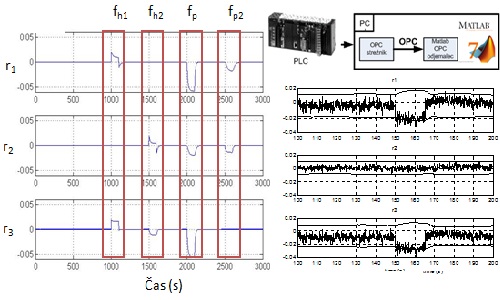
Most industrial processes today are controlled automatically under the supervision of an operator, who manages the process in line with the requirements and procedures of the technology. The automation system takes care of control and the execution of control loops, the transfer of information between systems and the operator, basic protection, etc. Disturbances, environmental influences and component ageing are just some of the causes of malfunction, where, besides technological, environmental and safety aspects, the most exposed is the economic loss due to an unplanned production stop. Fault detection, isolation and diagnosis subsystems are becoming an integral part of automation systems, primarily to achieve faster response and coordination of fault correction, with the main goal of detecting a fault early, before it develops into a failure.
Fault detection in industrial processes, however, is not as simple as it seems. The most common limitations are outdated equipment, insufficient knowledge of the processes and distrust of the system because of false alarms… But as the level of automation in industry rises and hardware and software develop, it is increasingly possible to build these systems into smaller and cheaper processes, using methods that were previously very difficult to implement (statistical approaches, demanding data processing, advanced control algorithms). A fault detection system is primarily intended to warn operators and assist their intervention, so real-time operation and detection of the irregularities it is designed for are desirable.